Archaic Greece and the Turmoil of War
Ancient Greek online course, 18 November- 16 December, 2026
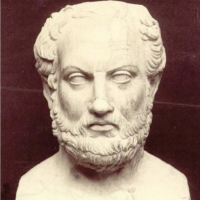
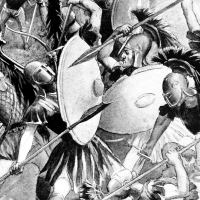
Thucydides, son of Oloros, is traditionally considered one of the most difficult authors in Greek literature. This view is shared not only by our contemporaries but was already held by the ancients, if it is true that Cicero—who admired the incredibly taut and dense style of the *Histories*—admitted to having difficulty deciphering some of its passages. One gets the impression that Thucydides’s language is like a goldsmith’s burin, capable of etching the events of the Peloponnesian War into deep yet extremely fine engravings; and this is evident from the very first pages of Book I, which describe the state of archaic Greece and the more or less latent tensions that led to the outbreak of the Peloponnesian War.
In this course, which will be conducted entirely in Ancient Greek, we will focus on reading the most significant passages from Book I, selected to offer students a variety of themes and to highlight the sharpness of Thucydides’ thought and the various virtues of his narrative. We will come to deeply appreciate this unmistakable voice, in which resonates a tragic sense of human existence that is more subtle—but no less powerful—than the one that unfolded, in the same era, in the Theater of Dionysus.
Last Day to Register: 17 November, 2026
| Schedule | Topic |
| I. Wednesday 18 November, 18:00-19:15 CEST, zoom webinar | The best soil is the most barren (webinar) |
| II. Wednesday 25 November, 18:00-19:15 CEST, zoom webinar | Thalassocracy and Piracy (webinar) |
| III. Wednesday 2 December, 18:00-19:15 CEST zoom webinar | After the Persian Defeat (webinar) |
| IV. Wednesday 9 December, 18:00-19:15 CEST zoom webinar | The Crisis in Corcyra and Pericles’ Speech (webinar) |
| V. Wednesday 16 December, 18:00-19:15 CEST, zoom meeting | The Last Days of Peace. A Conversation in Ancient Greek (meeting) |
Course Syllabus
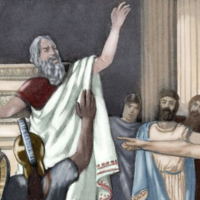
The first two lectures will be devoted to the study of ἀρχαιολογία, the section in which Thucydides reconstructs the history of Greece as a whole: from ancient piracy to the maritime empire of Minos, from the indigenous origins of the Attic people to the founding of colonies, while also delving into certain aspects of customs, such as changes in Athenian fashion during the Archaic period. The third and fourth lectures will be devoted to the so-called “pentakontaetia,” the period of peace between the Persian Wars and the outbreak of the conflict between Athens and Sparta—a period analyzed by Thucydides with a keen understanding of the mechanisms of power and diplomatic subtleties. The course will culminate with a reading of Pericles’ speech, a passage so famous that it has been memorized by generations of Greeks and Byzantines. The fifth lesson will take the form of a discussion and will give students the opportunity to interact with the teacher and discuss the topic of war in Ancient Greek.
An In-Depth Reading of Thucydides
With this series of lectures, Schola Humanistica launches a course dedicated to reading Thucydides’ work and studying the geopolitics of the ancient world. Each chapter of this series will present a self-contained and coherent discussion, so that listeners can follow along without feeling at a disadvantage for not having attended the previous sessions.